
It’s a truism that development never stops. This is certainly the case for equipment used in transport across the polar ice cap(s). In every case, the aim is to deliver what’s needed at the best cost and with reduced impact. In the sledge category, development has followed several directions. The main ones have focused on two points: reducing dead weight and reducing traction effort. A third point has also received attention: reliability, or minimising maintenance.
As a result, skis have given way to mats for certain loads, and platforms have been removed wherever possible. These developments come as much from technical thinking and design work as from adapting to constraints and requirements raised by end users.
Five projects and concepts evaluated
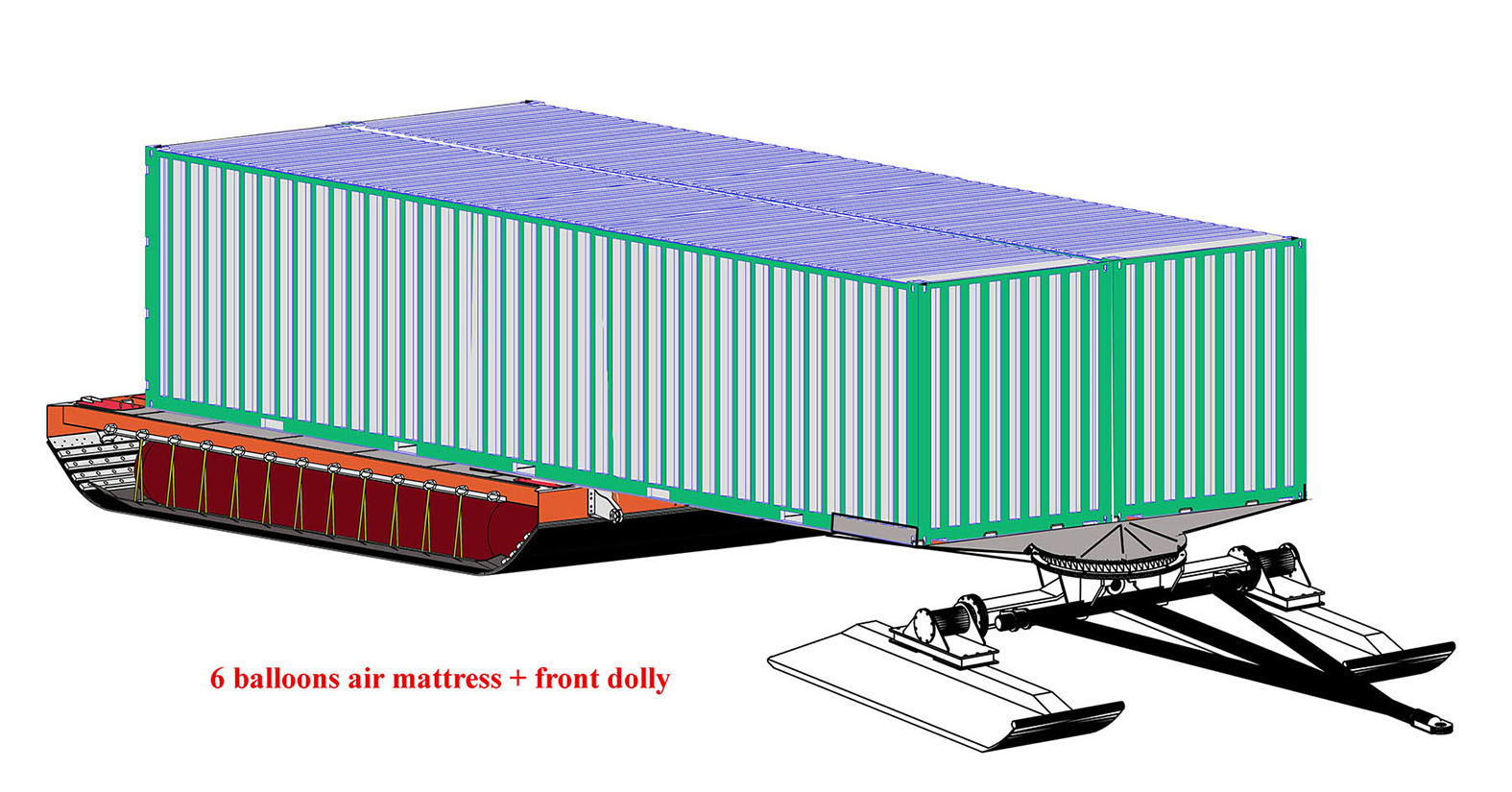
Combination of mattress sled and front dolly with skis
1) Large-capacity sledge for very heavy loads: Given that, depending on terrain conditions, it can be difficult to use a 12 m (or longer) air-mattress sledge, the unit is split in two, combining a rear section carried on a 6 m air mattress with a front section on skis, to maintain a lever effect for steering the platform. The size shown allows for the joint transport of two 40′ containers – 4900 mm wide by 12,200 mm long – or a single item of high weight or large volume. The limiting factor is the size of the crane needed to handle such a load.
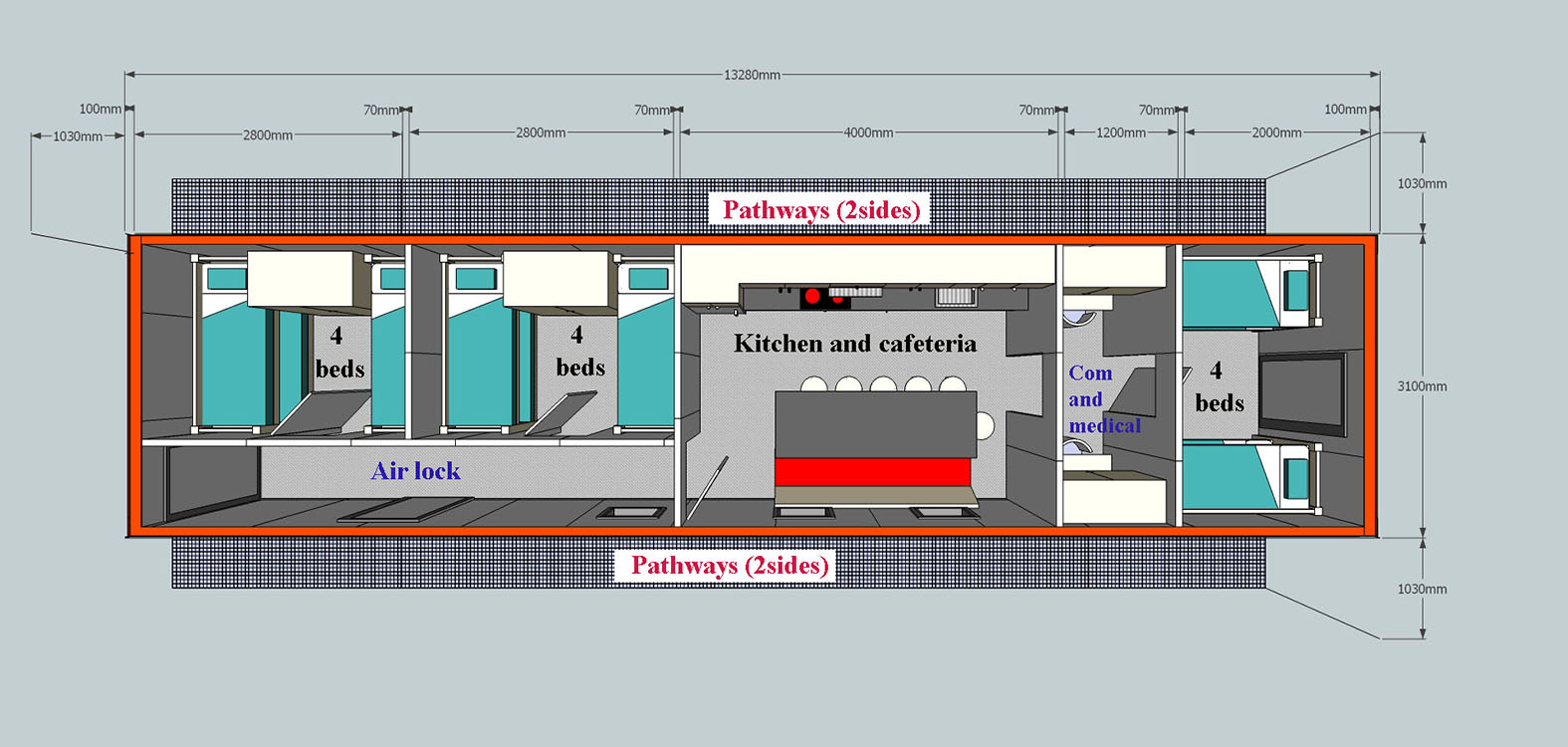
caravans design
2) Combined 12-berth living unit and power unit: The configuration shown follows the layout principles of units already in service. The standard width is 3100 mm, while the length is 13,800 mm for the living module and 8700 mm for the power module.
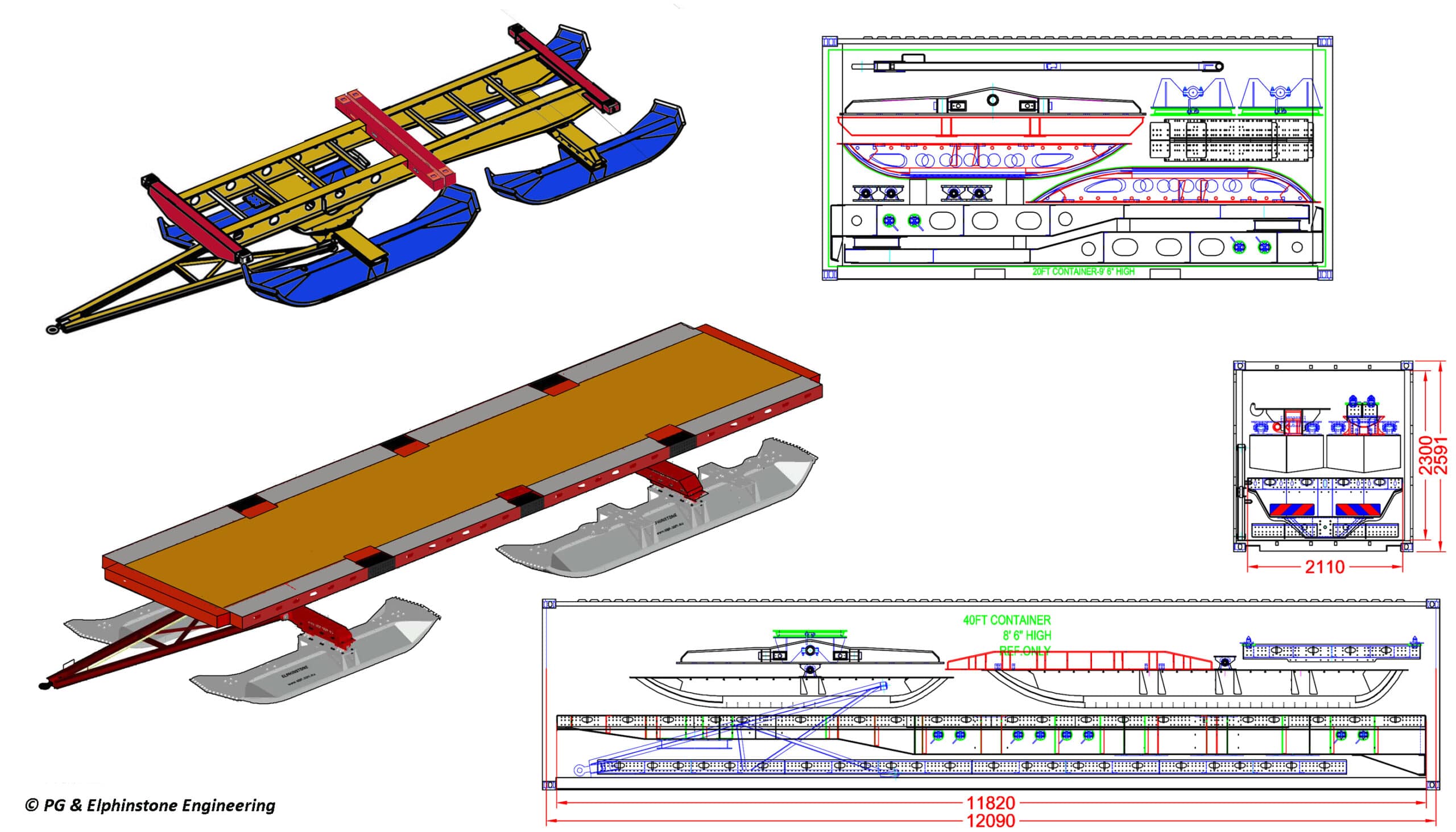
into 20′ and 40′ containers
3) Demountable sledge for transport in standard containers: It can be worthwhile to purchase a sledge from a manufacturer located far from the operating site. This raises the question of transport, and with it, compatibility with standard 20′ and 40′ shipping container dimensions. The equipment shown is compatible with these sizes and, once reassembled, is itself able to be loaded within this same container format.
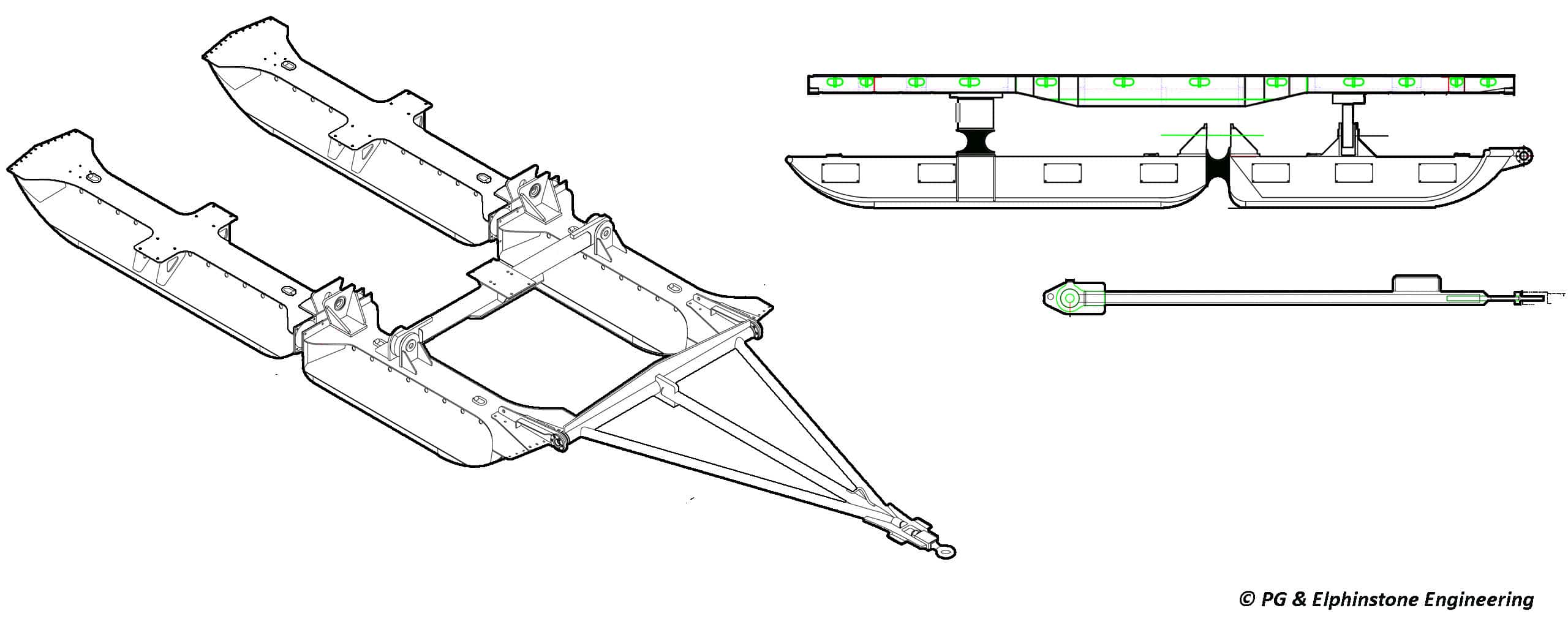
a base of 12 m³ sledge tank
4) Removal of front-axle steering for a 20′-capacity sledge: Starting from the observation that the 12 m³ tank sledge, with a laden mass of 14 t and an overall length of 6 m, has no front axle, it can be worthwhile applying this same kinematic layout to a cargo sledge, producing a sledge that is both compatible with 20′ container transport and able to be loaded within this same format (see point 3).
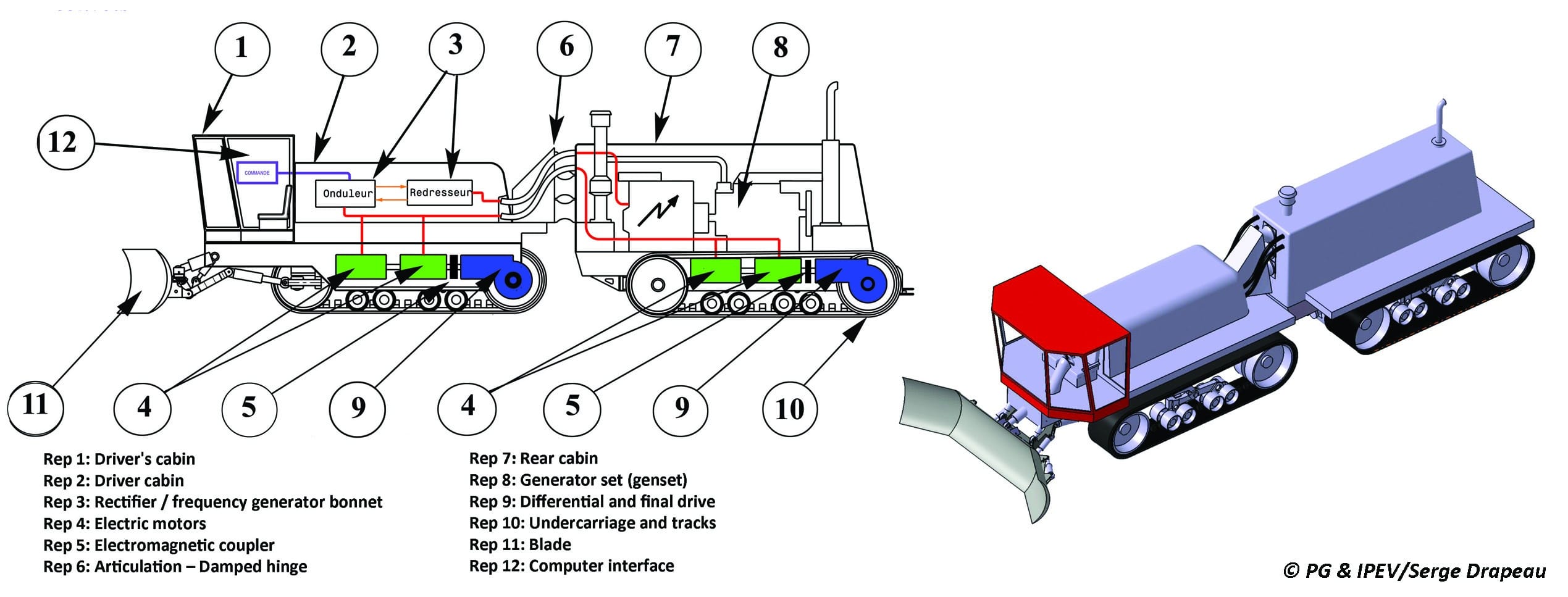
5) Proposed diesel-electric conversion based on reusing the undercarriages and chassis of Challenger 65 tractors. The first generation of Challenger tractors (the 65s) is nearing the end of its working life. The engines, already identified as the weak point of this machine, along with the gearboxes (transmission), can no longer be considered reliable. The rest of the machine, however — chassis, differential/final drive assembly, undercarriage — is a priori in good condition and can be reused. The idea is to join two chassis using a semi-elastic articulation, effectively creating a 4-tracked machine, and to replace the direct diesel drive with an electric intermediate stage.
The resulting 4-tracked tractor would consist of two coupled platforms. One platform would carry a 1000 kW generator set, the other the driver’s cabin and the rectifier-inverter unit. Electric motors, fitted in both chassis at the input to the differentials, would be driven by the inverters/frequency generators. Overall synchronisation would be controlled through the driver’s cabin control interface — a computer interface handling start-up, cruising operation, shutdown of the coupled unit, and automatic monitoring of components.