
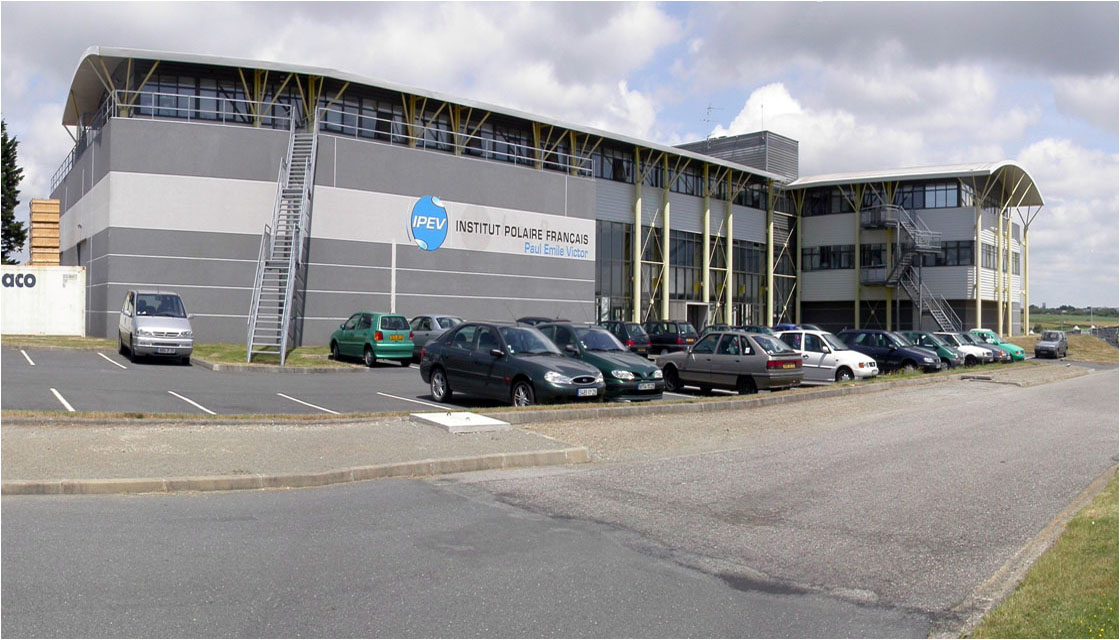
IPEV, the French Polar Institute Paul Émile Victor, is dedicated to implementing scientific programmes in environments whose specific characteristics — climate, isolation, remoteness — require specialised skills and technologies. Operationally, it is the French agency responsible for logistical support to scientific research in the polar regions. Established in 1992, it took over from the French Polar Expeditions of Paul Émile Victor.
In practical terms, IPEV oversees scientific activities and installations across the three Austral districts of the TAAF Territory (Kerguelen, Amsterdam and Saint-Paul, the Crozet Islands), as well as scientific activities in Svalbard. In Adélie Land, it manages technical and logistical operations — maintenance and development — under the administrative authority of that territory. Beyond this, it also operates at sites outside Adélie Land, such as Concordia, independently of the TAAF territorial framework.
IPEV supports national and international scientific programmes, ensures the operation of observatories, and guarantees the conditions necessary for extended stays in regions where isolation and climate demand a high level of technical expertise. It is responsible for the construction, management and upkeep of infrastructure and autonomous stations, and maintains the mobile resources enabling safe access to the continent.
On the administrative side, IPEV is a Groupement d’Intérêt Public (GIP) — a Public Interest Group. This legal structure allows a specific activity to be carried out as a distinct entity, formalising a partnership between several public bodies under flexible statutory rules. It provides a less restrictive framework than full public establishment status, and a more robust one than the associative model used by the former French Polar Expeditions.
The Institute represents France in international discussions on polar environments and promotes the standing of French polar research. It collaborates with its foreign counterparts, builds international partnerships, and participates in negotiations on the Antarctic Treaty and the Madrid Protocol.
Supported scientific programmes are selected by the Scientific Council, which comprises up to nine members chosen for their expertise in the Institute’s fields of activity, at least one third of whom are of foreign nationality. Members are appointed by the General Assembly for a four-year renewable term.