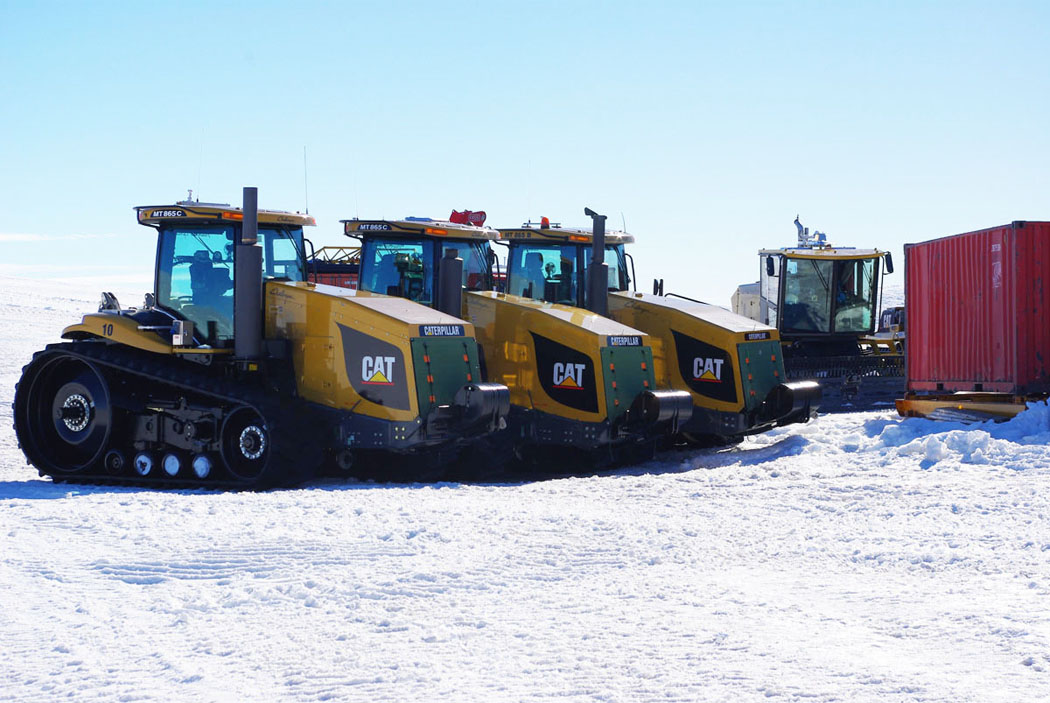
Convoys operate with two types of machines that complement each other for this task: traction machines and grooming machines, which allow the traction machines to work efficiently by travelling on a groomed, reasonably compacted track.

Choice of tractors

At the time the project began (in 1989) and equipment was being sourced, only three categories of tractor on the world market held our attention:

• Caterpillar D-series bulldozers used as tractors

• Caterpillar Challenger agricultural tractors, which first appeared in the early 1980s

• Kässbohrer PistenBully (PB) ski-slope groomers

The Caterpillar D-series bulldozers in LGP configuration, used at the time by polar operators, were excellent machines but slow and heavy; they were eventually phased out in favour of these newer traction machines, the Challenger series. Designed to work on soft ground, these tractors run on continuous elastomer tracks. A series of modifications allowed their use during the Antarctic summer season.

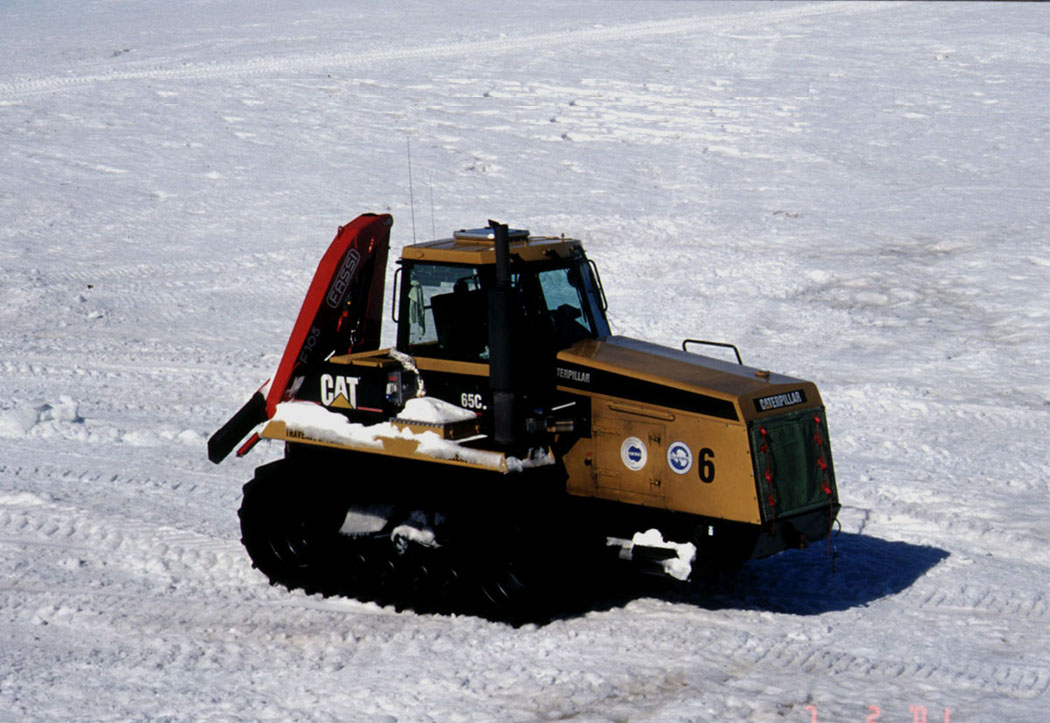
Caterpillar Challenger 65 C&D - machines 2 to 7 in the Concordia convoy system
Caterpillar Challenger 2 to 7 series 65 C&D
Original fleet of tractors for the Concordia convoy system
Caterpillar Challenger 1
Caterpillar Challenger 1 serie 65 A
The first machine in the Concordia convoy system

Prepared by William Adams, the Caterpillar agent in Tasmania, the first Challenger C65 A machine was field-tested successfully during the 90/91 austral summer. A second machine (65 C) was acquired in 1994. This one benefited from the experience gained with machine A and was the first to be adapted to Antarctic conditions — “winterised”, to use the field term. Most of these modifications have since been carried over to every machine acquired since.

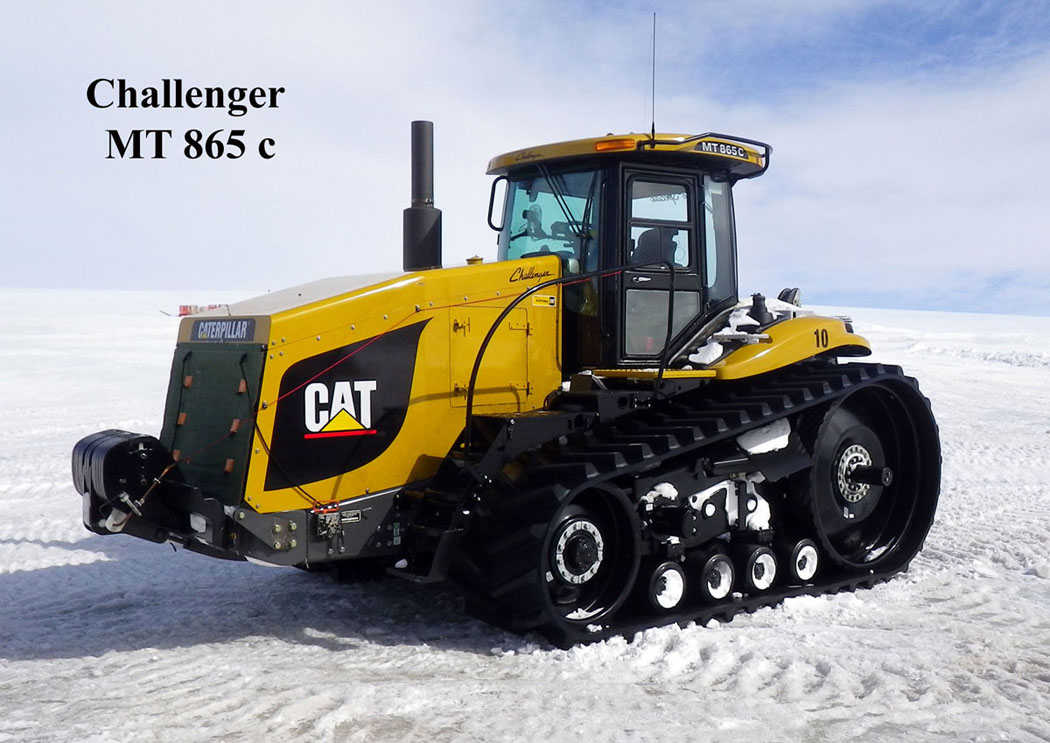
Traverse - Challenger MT 865 Tractor
Agco Challenger MT865 serie
Traverse - Challenger MT 865 Tractor
AGCO Challenger MT865 serie
Concordia Fleet – Tractors 9 to 15

Evolution

From 2009, the 65 series was gradually phased out for Concordia resupply convoys and replaced by the MT 800 series. The C65 generation moved over to scientific traverse work. The oldest C65 machine now has 32 years of service behind it.

Caterpillar Challenger in operation at the station during bad weather
Challenger 65x and MT 865x in operation
Evening stop during bad weather
Caterpillar Challenger MT 8xx series
Agco Challenger MT865 series undergoing winterisation
William Adams Workshop – Hobart

Characteristics

Challenger tractors, older and newer models alike, use around 6 litres of diesel per kilometre when loaded, and between 3 and 3.5 litres when empty. The original models (C65x series), fitted with 36-inch tracks, have a low ground pressure (300 hPa), a 220 kW engine, and a simple, robust design. They run a 10-speed semi-automatic transmission. Their operating weight is 16,000 kg, with a maximum empty speed of 30 km/h and a loaded cruising speed of 9 to 10 km/h.

The MT 800, with an operating mass of 22,000 kg, is fitted with 400 kW engines and can reach a maximum empty speed of 40 km/h. Ground pressure is 350 hPa. Loaded cruising speed ranges between 12 and 18 km/h. The shared-load towing mode with two or three machines has been retained.

While a pair of C65s could tow 8 standard loads (equivalent to 12-tonne 20-foot containers), a pair of MT 865 tractors can tow 12 load-equivalents — around 144 tonnes net, or 200 tonnes gross including sledge weight. The extra power available means the engine is worked less hard, now running at 85% of capacity rather than 100% continuously as with the C65. This power reserve would, in principle, allow the train to reach a noticeably higher cruising speed than with the C65s, but this carries a risk of damaging the towed sledges and cargo. Loaded speed is therefore generally kept to 12–14 km/h.

15 t.m Fassi auxiliary crane at the rear of a Caterpillar Challenger MT
Agco Challenger MT865 series
Fitted with a 15 t.m Fassi auxiliary crane
20T hydraulic winch on the Challenger MT
Agco Challenger MT865 series
Fitted with a 20-tonne hydraulic winch

Adaptations and modifications (known as “winterisation”)

Modifications and adjustments allow the tractors to operate reliably and effectively in an environment where average summer temperatures range from -20°C to -50°C, on an ice cap (limited ground bearing pressure) and under minimum atmospheric pressure equivalent to an altitude of 3,600 m. Preparation and polar-service modifications are similar for both the C65x series and the MT 800.

Four types of rear-mounted equipment and accessories complete the winterisation package as needed: a 3-point agricultural hitch, a 400 V three-phase 40 kW generator mounted on the power take-off, an 11 t.m hydraulic crane (extended to 15 t.m on the MT 800), and a 20-tonne traction winch. Across the fleet of 7 tractors (6 in service on a convoy), there are typically 2 machines fitted with generators, 3 with cranes, 1 with the lifting hitch, and 1 with the winch, alternated according to the work required.

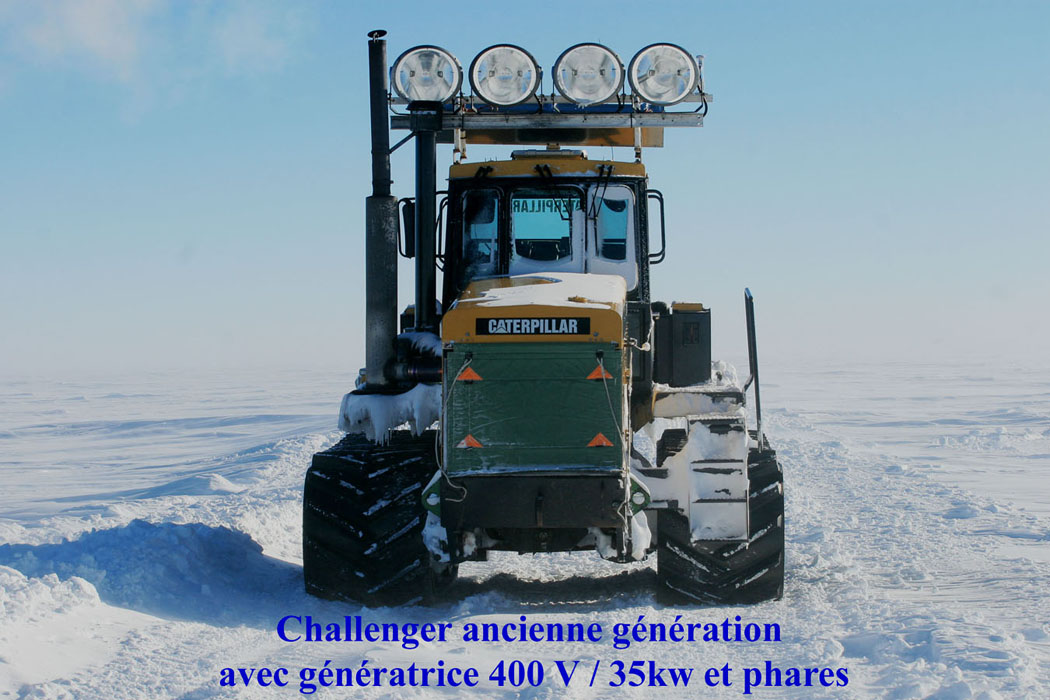
40 kW Leroy Somer alternator fitted to the Challenger
Agco Challenger MT865 series fitted with
A 40 kW Leroy Somer alternator on the rear PTO
Challenger tractor fitted with 3 x 2000 W floodlights
Agco Challenger MT865 series fitted with
3 x 2000 W Philips Arena floodlights

Notes

They are designed to tow continuously without durability issues. They can, however, lose traction on dry, “low-cohesion” snow. By design, they are not fitted with a blade; attempts to fit one have not succeeded without a complete modification of the machine (excessive pitching, poor visibility). Mechanically, they can tow safely at maximum load, since track slip occurs before any excessive mechanical strain. Towing at maximum load can, however, cause the tractor to become bogged on uneven terrain (bumps, sastrugi, etc.). This difficulty, inherent to a poor-quality surface such as névé, has been overcome by coupling the machines in tandem and redistributing the loads between them.

Marketing of the tractors, originally under the Caterpillar name, has changed over time. With the introduction of the MT series (MT 700, 800), Challenger became a subsidiary transferred to the AGCO conglomerate. AGCO changed the branding again with the introduction of the third generation: the machines are now sold under the Fendt brand. While the overall concept and appearance remain the same, they are fitted with a MAN engine and a continuously variable transmission, known as Vario Drive, which continuously matches engine torque to rotation speed. The most powerful model produces 470 kW.

Preparation for Antarctic service on these third-generation machines remains the same.

Standard 2025 Agco Fendt MT11xx series tractor