1 – General information
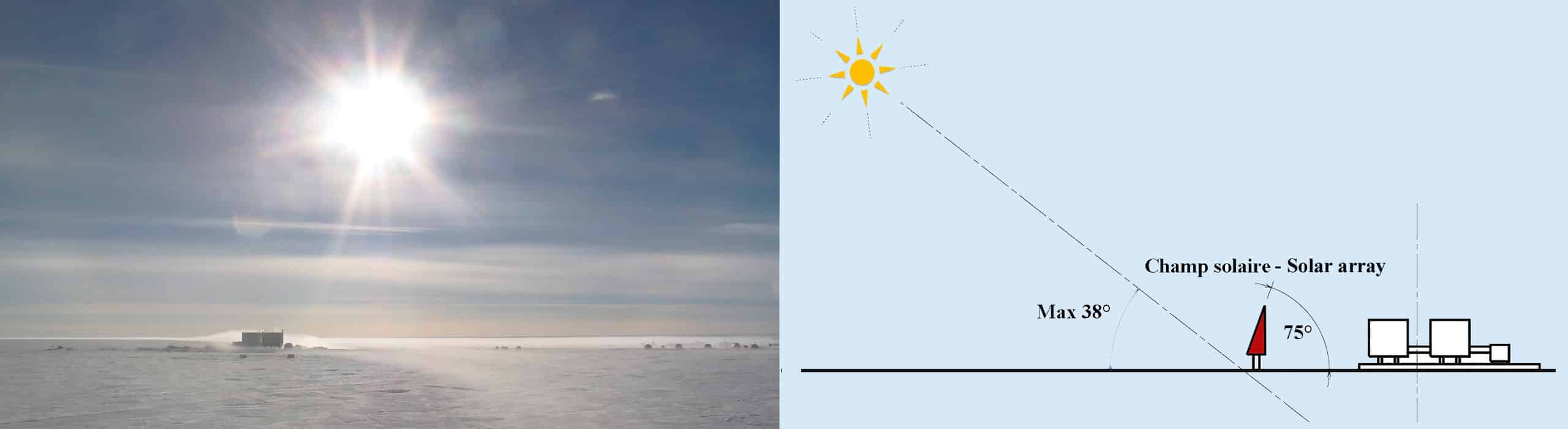
Isolated on the Antarctic plateau, Concordia runs on complete energy self-sufficiency, with Diesel consumption of 260 to 300 m³ a year, to which must be added the fuel delivered by traverse convoys. Limiting, or better still reducing, this dependence has always been one of the station’s management priorities. It rests on three combined levers: reducing demand, improving efficiency, and drawing on local renewable sources. Reducing demand was one of the project’s starting constraints. Conventional wind power was ruled out: ground-level winds (4-5 m/s) are too weak, and installing a large wind turbine raises major technical difficulties, such as delivering a crane big enough for the job. Solar power, on the other hand, benefits from exceptional conditions – a flat, open site, low cloud cover, high albedo, and low temperatures that favour cell efficiency – limited only by the total absence of sunlight during the 4 to 5 months of the winter trough, which nonetheless makes it necessary to keep a Diesel power station.
2 – Solar field installation layout
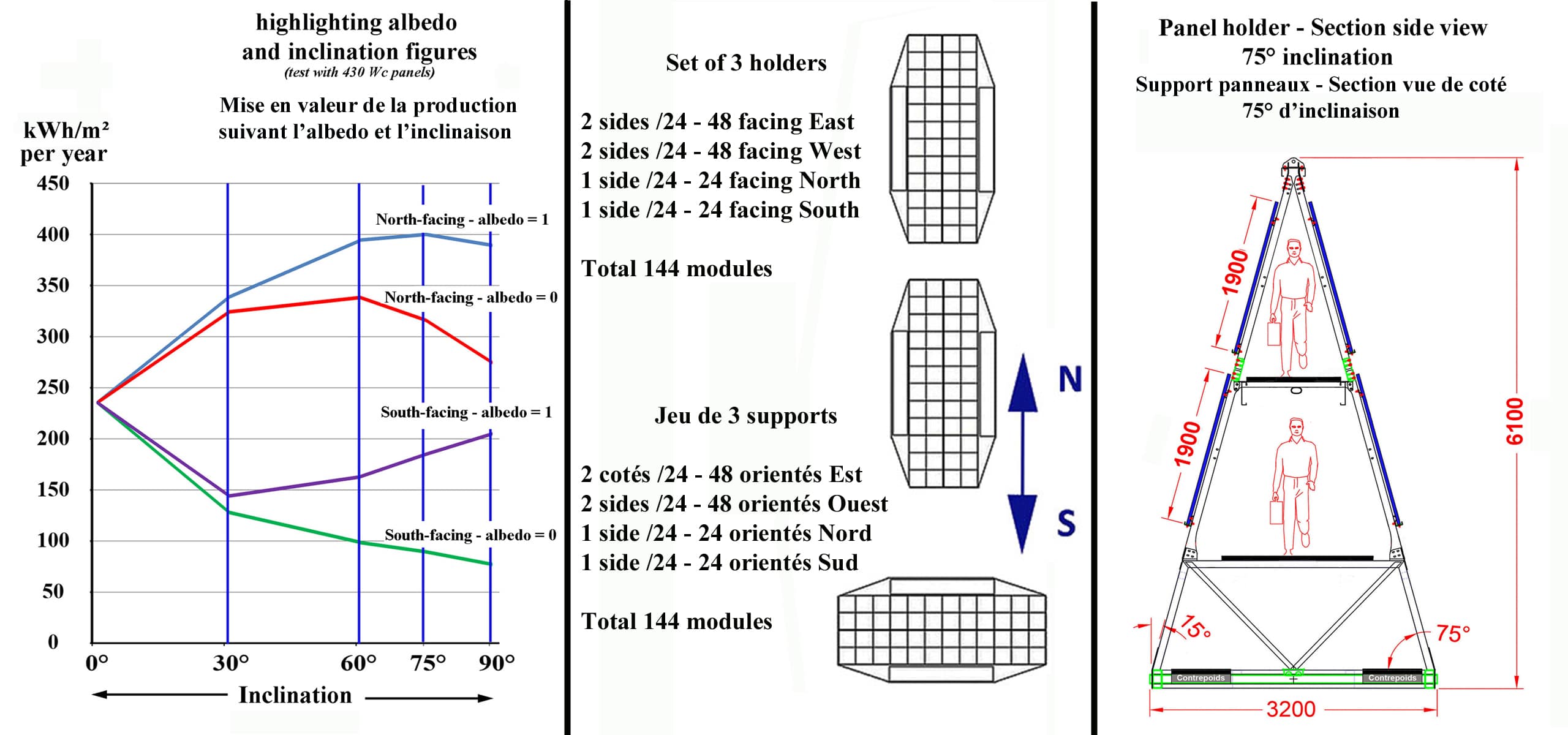
Setting up a solar field calls for three types of equipment: the panels themselves, the equipment linking the array to the grid (here provided by the Diesel power station), and the mounting structures. At Concordia, rather than spreading panels across facades and roofs, it was decided to group them on steel-framed supports set away from the buildings. The development approach was worked out in four stages, ranging from simply offsetting summer overconsumption through to near-complete coverage paired with year-round storage. For the layout itself, an annual production cost calculation, run using PVsyst software, compared a rotating-frame configuration against six fixed orientations. The East-West layout – panels tilted at 75° – showed the best payback cost per kWh produced. It is paired, for one third of the array, with a North-South set, to avoid the midday production dip that the East-West configuration produces. It is worth noting that the south-facing orientation also performs efficiently: south-facing panels certainly produce less than north-facing ones, but remain worthwhile thanks to albedo and the continuous daylight from November through to the end of January.
Proposed groupings and orientations
3 – Test installations and initial production
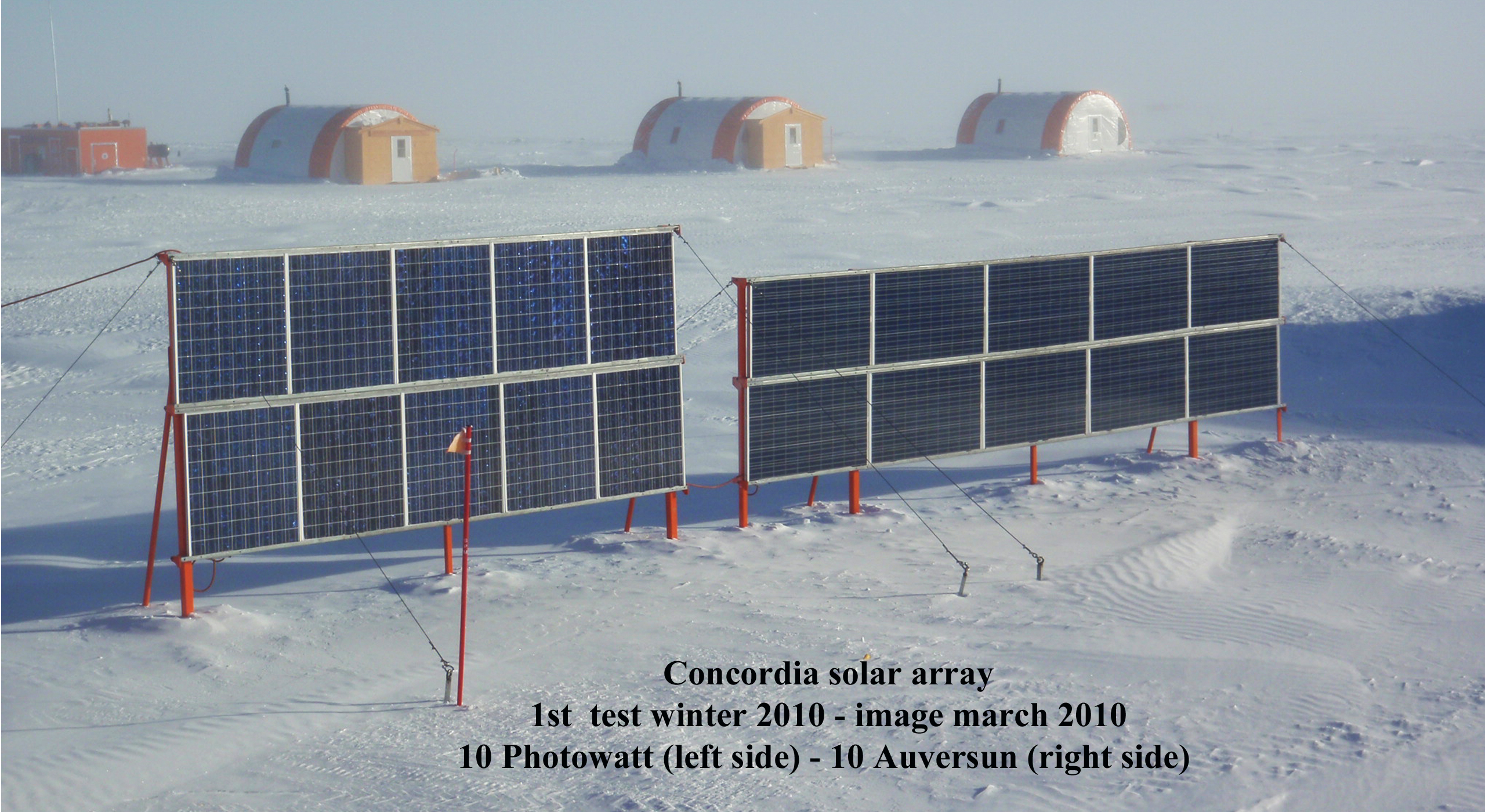
Winding the clock back a little, the first comparative trials were run as early as 2010, with 10 Auversun 210 W panels and 10 Photowatt 210 W panels. Auversun was chosen at the time for its better production bonus over theoretical estimates under site conditions. This test installation already confirmed the welcome surprise of overproduction due to the low temperatures, the site’s optical qualities (dry, pollutant-free atmosphere) and the exceptional albedo. The panels came through the winter, with lows down to −80 °C, without suffering any physical damage.
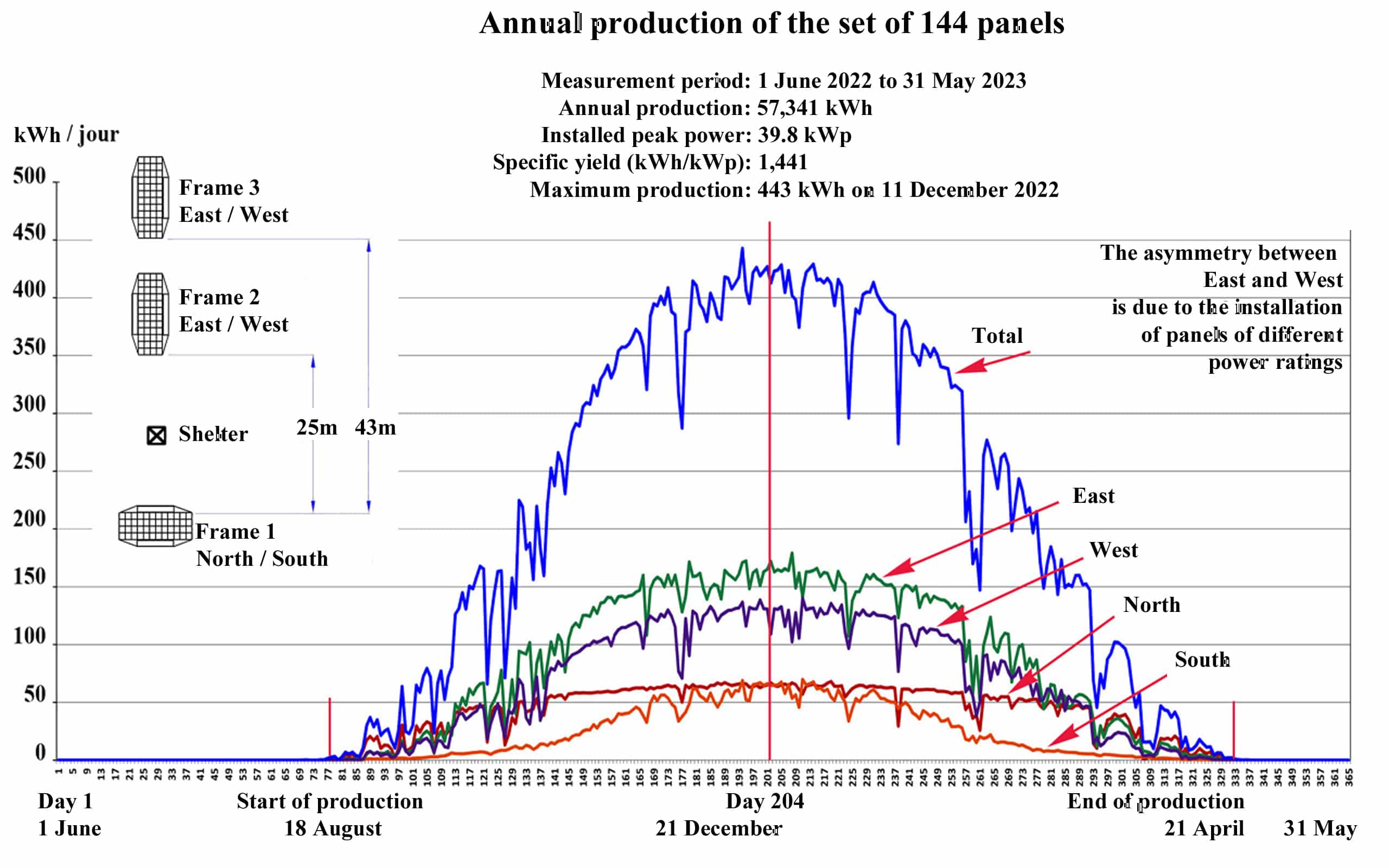
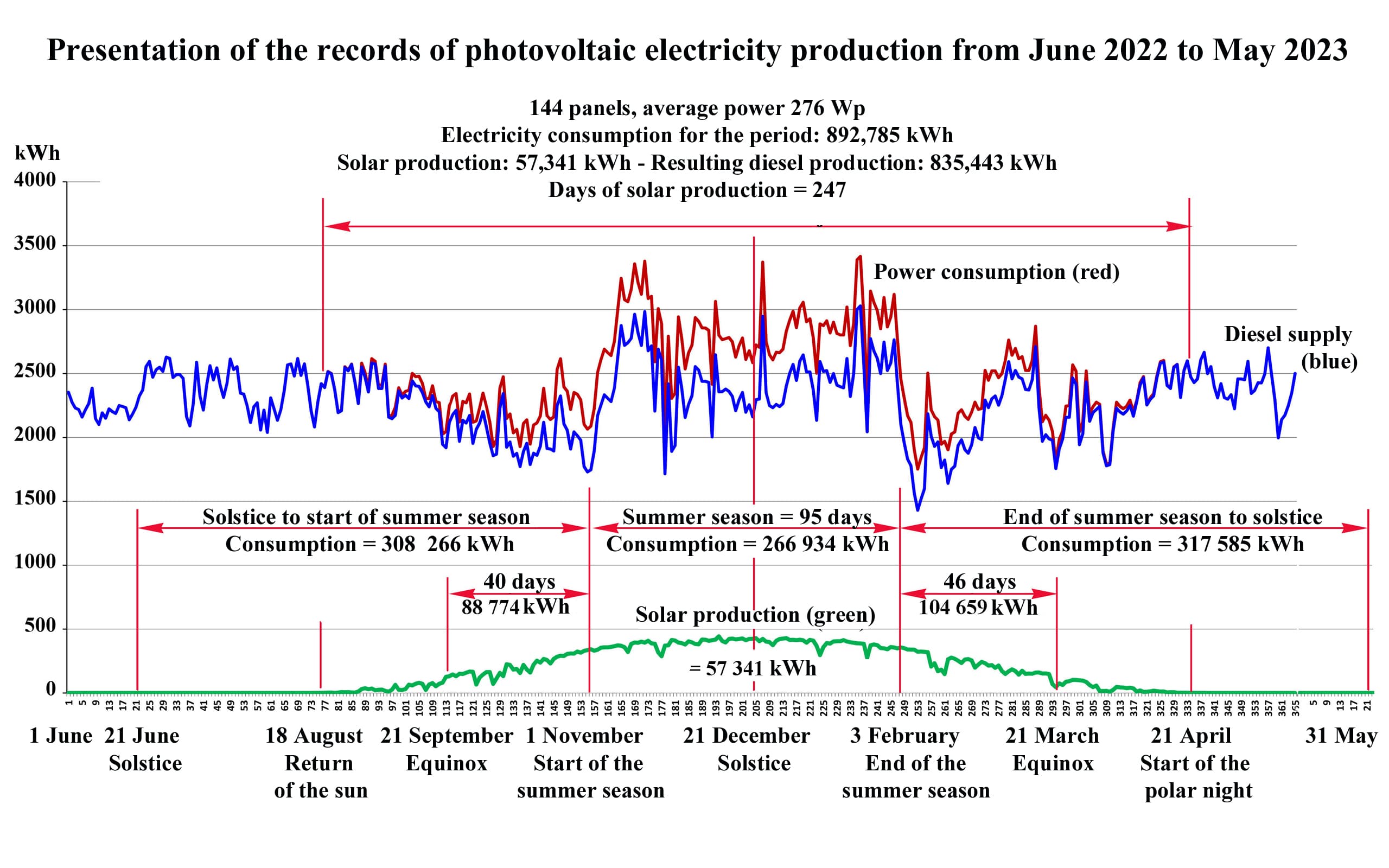
With Auversun and Photowatt later disappearing from the market, a second, more industrial installation (11 kWp, 48 panels from various makers, 4 SMA three-phase inverters) was commissioned some time later. Spread across the defined orientations on the planned fixed supports, the panels produced 19,000 kWh over the year – output again 25% above the calculated forecast, as the software does not account for the gains from the cold and the atmosphere’s exceptional clarity. This 1.25 correction factor was then used as the reference for all subsequent projections. The field was expanded to 144 panels in 2022, again trialling several manufacturers across the three supports, for an average peak output of 276 W per panel (as panels evolve quickly, it is necessary to stay as close as possible to what is currently on the market). Measured production reached 57,000 kWh over a year for the 144 panels.
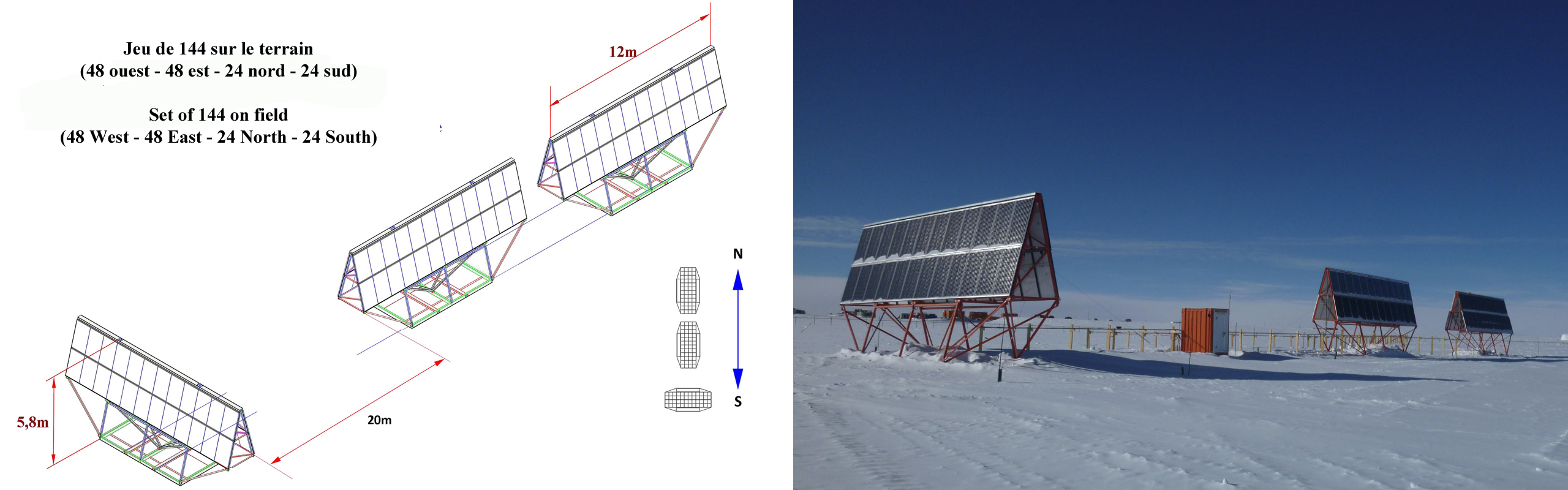
Group No. 1
4 – Simulations and extension projections
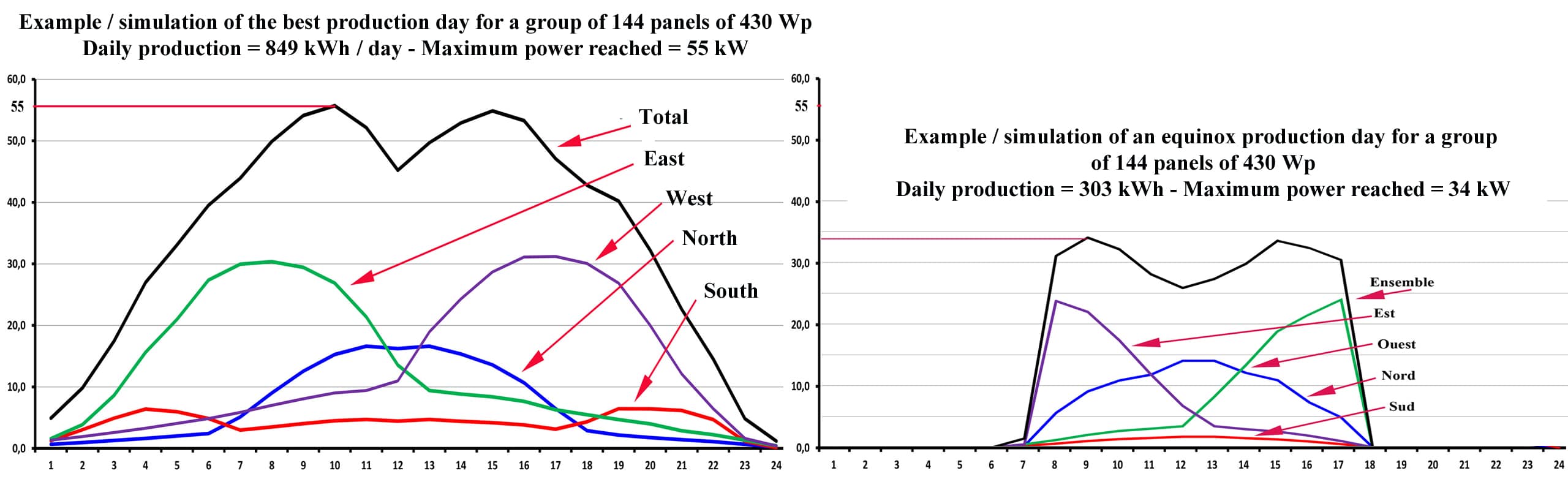
With this good level of production, the plan to add a further bank of 144 recent panels (430 Wp – 62 kWp for the field) quickly raised a fundamental question: since each bank can reach an instantaneous output of 55 kW (see the typical daily output graph), combining it with the first field pushes the Diesel generators’ load below their permissible minimum-load threshold, set at 50% for the models in service. Two solutions then present themselves: switch to a generator model that tolerates a lower threshold, or shift the electrical architecture towards philosophy 3 and reverse how the power station is run, so that storage and the solar field now drive the grid.
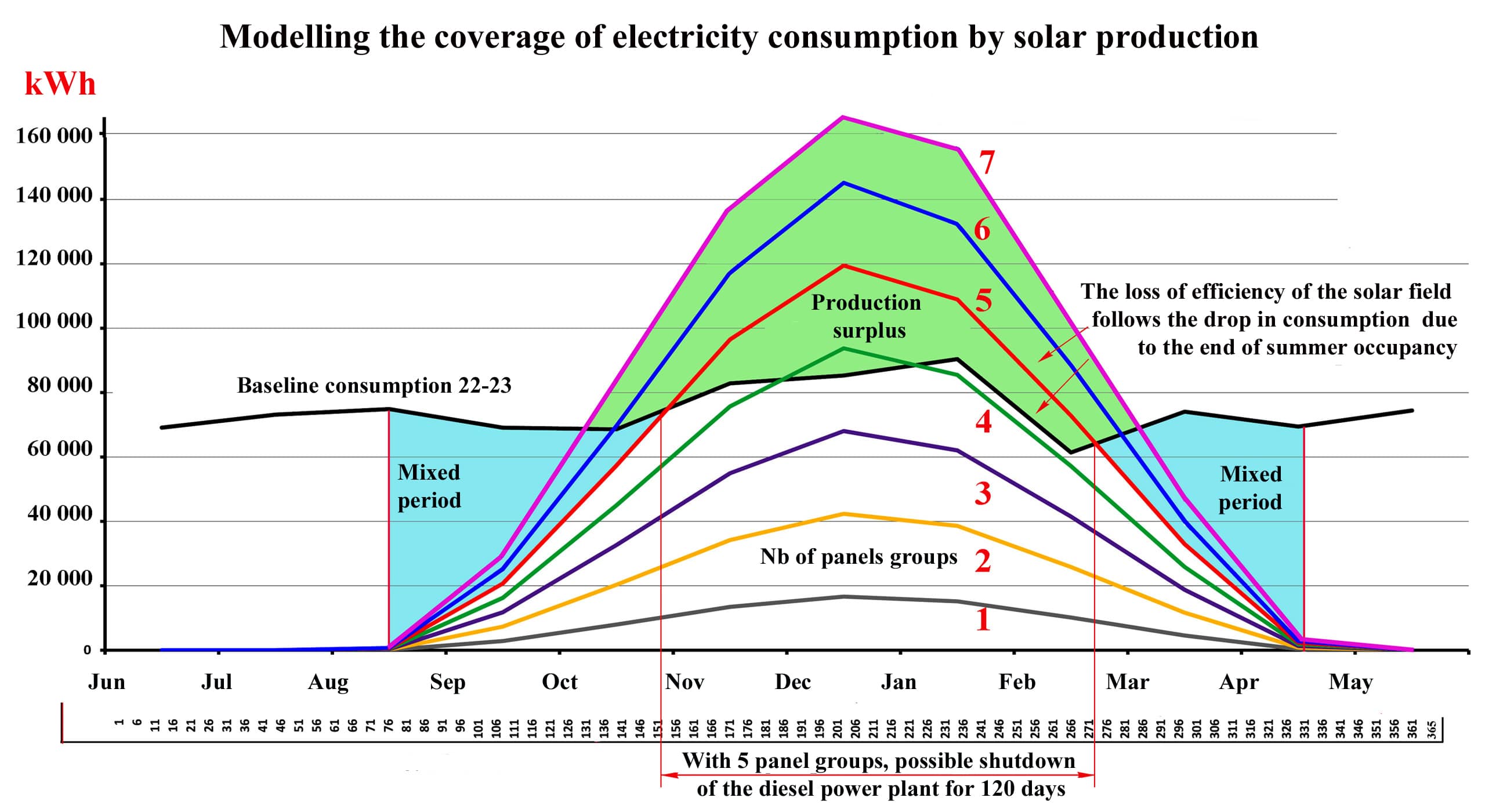
Highlighting coverage rates
This change is a major one, as it means installing the storage bank and inverters capable of managing the grid all at once rather than gradually, with the Diesel plant then becoming a back-up in summer. For a complete philosophy-3 setup, if the set of 3 supports / 144 modules is fitted with the recent 430 Wp panels, giving 110,000 kWh of production a year, simulations show that from 4 banks installed onward, solar coverage becomes self-sufficient and the Diesel plant can be shut down for 31 summer days, with surplus output recoverable for heating needs. Pushing to 5 banks extends this shutdown by a further 100 days.
5 – Connection and storage equipment – operating materials
At present, solar input is a top-up that automatically offsets the power station’s output. The end goal is to scale it up so that the renewable installation becomes the primary source of production during the favourable part of the year, while still being backed up as needed and without outages from the thermal power station. The solar system will comprise the panels (as defined in chapter 4 – which sets the time period to be covered), a storage bank to be sized according to the number of panels, and an electrical management system able to handle the different sources simultaneously. The chosen technology is SMA/Sunny Island. The system is built around a so-called multicluster concentrator cabinet that brings all the sources (panels, batteries and generators) into line. The panels are connected to the cabinet via rectifiers, and the batteries via Sunny Boy inverters, which control the grid frequency and rank the sources according to the priorities set. The chosen sizing is 180 kW, with the system’s maximum capacity at 300 kW – a margin kept for future expansion. For storage, the technology chosen is lithium iron phosphate. In operation, one of the Sunny Boy inverters is set as grid master: it generates the frequency, synchronises and aligns the output of the other inverters, monitors battery charge and, when needed, sends the start signal to the generator on standby.
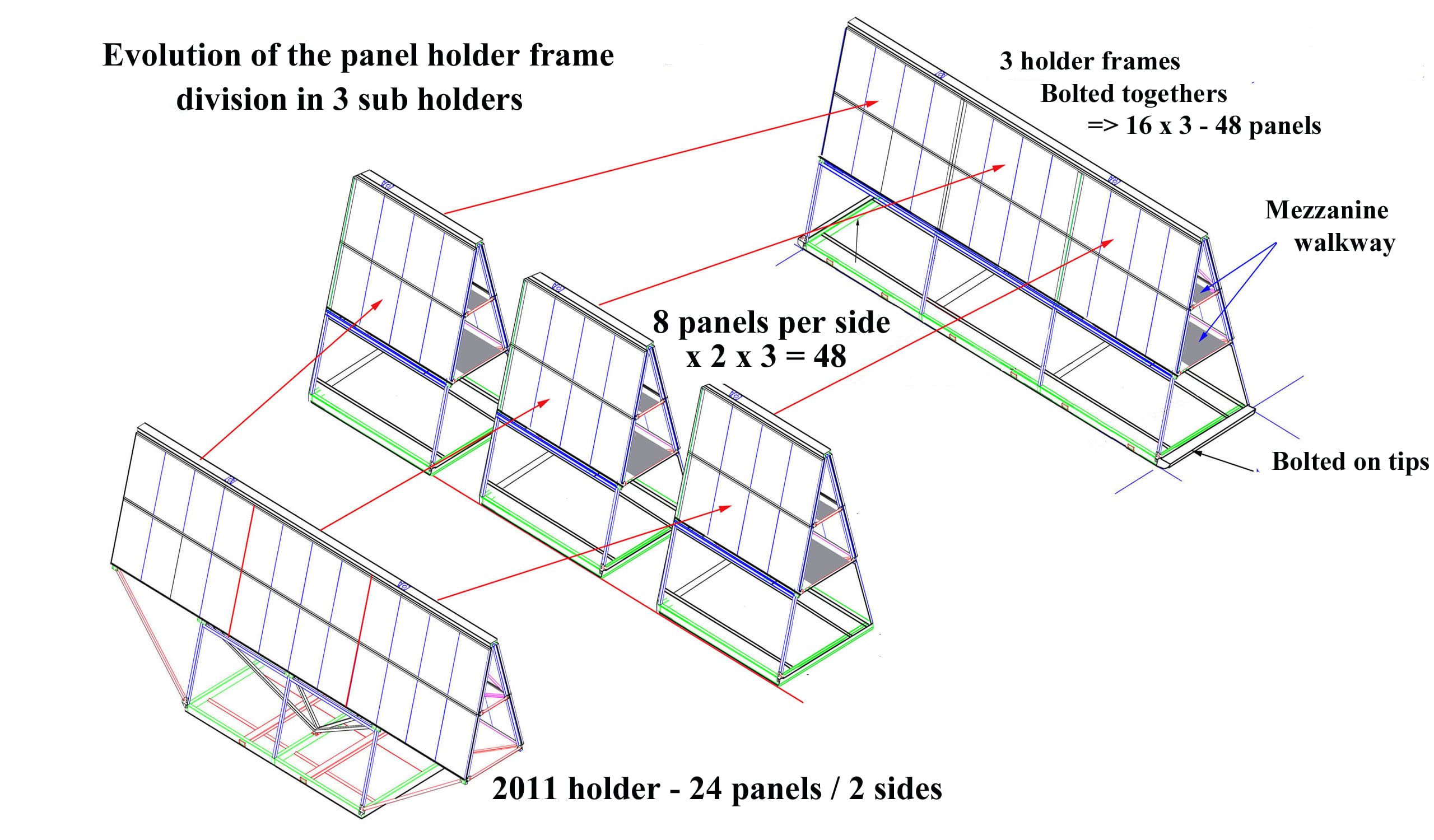
2025 design
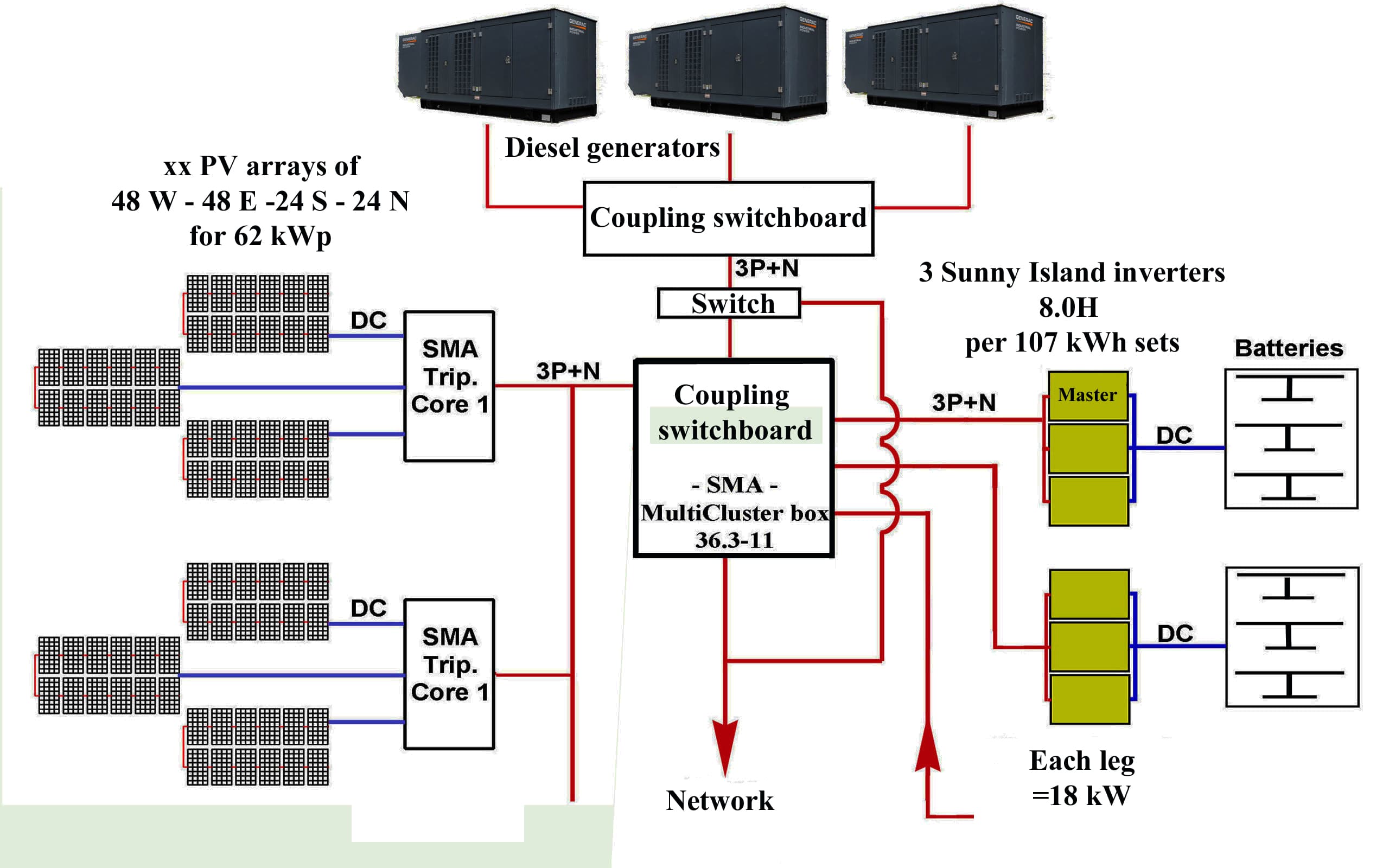
Based on SMA Sunny Island equipment
6 – Annual coverage question
A continuous summer shutdown of the station’s Diesel power supply cannot be considered without eventually raising the prospect of a full year-round shutdown. Yet no battery storage can cover the 5 months of partial or total absence of sunlight – only hydrogen storage, produced by electrolysis of water and then converted back to electricity via a fuel cell, remains feasible at this scale. The overall efficiency of the chain is around 42% (70% for electrolysis production, 60% for reconversion), which puts it behind batteries in terms of efficiency – it nonetheless remains the only option for large-capacity storage, with batteries keeping the advantage for daily storage. The energy that needs to be stored to cover the winter is estimated at 650,000 kWh, or around 19,500 kg of hydrogen, which represents a gas volume of 235,000 m³ at sea-level atmospheric pressure (360,000 m³ under Concordia conditions before compression). Given these efficiencies, producing this quantity would require around 920,000 kWh (920 MWh) upstream.
Beyond efficiency, hydrogen also raises safety concerns in an environment where dry air spontaneously builds up significant static electricity charges; it is a flammable gas whose combination with oxygen is explosive. Its very low density, despite a good energy density by mass, also complicates practical storage, which calls for costly, high-level technical equipment and highly specialised staff. A large-capacity hydrogen storage installation – whether at atmospheric pressure or compressed – is therefore not realistic as things stand: it would go beyond the technical skills a wintering-over team can manage. Producing the 920 MWh in summer would, moreover, require installing 15 banks of 144 panels dedicated solely to this hydrogen production.
This is why wind power, even though it seems, at first glance, of very little use, still warrants technical research into adapting off-the-shelf equipment, or into developing principles currently set aside.
7 – Building wall coverage
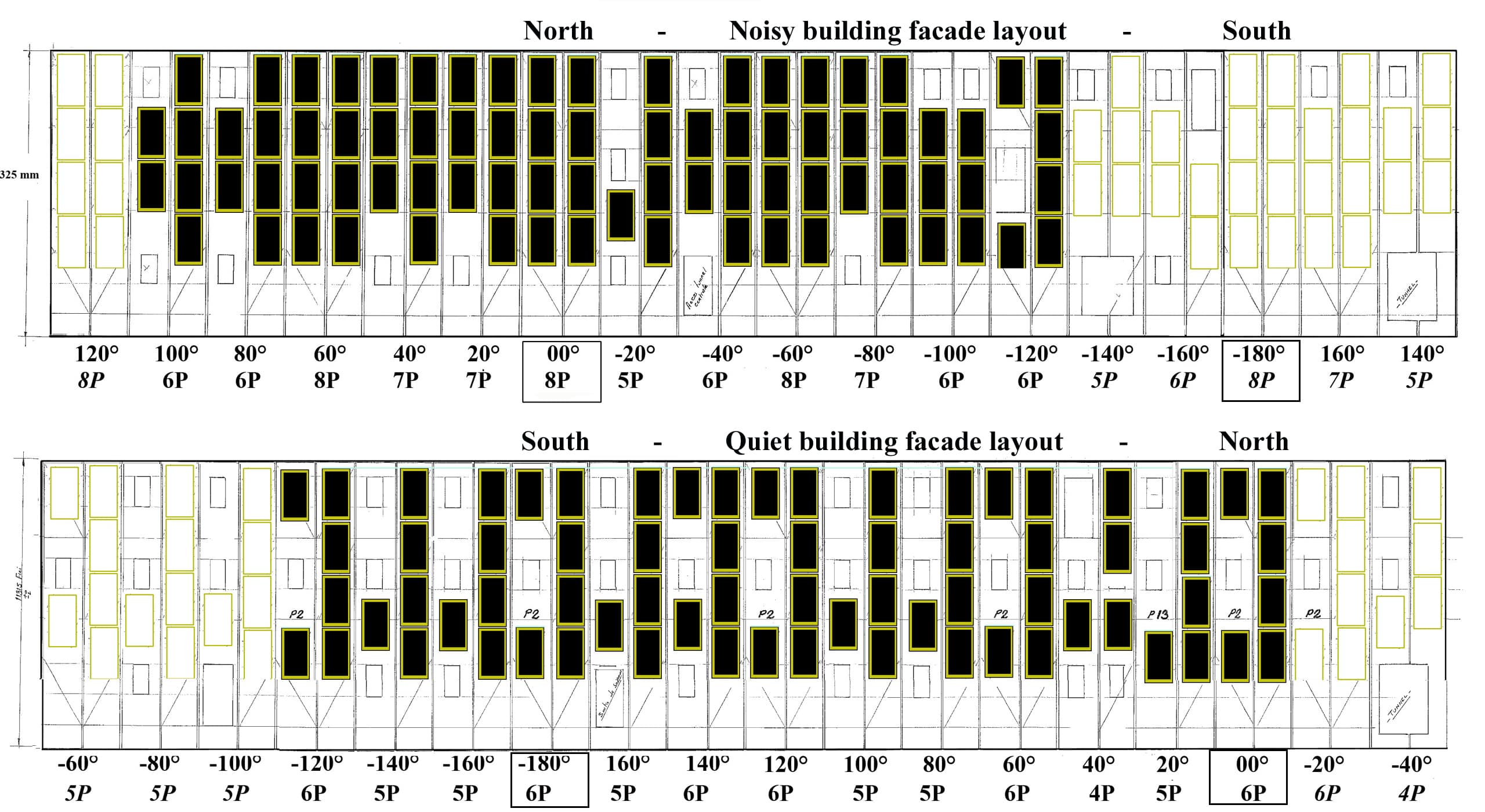
The idea of using building walls to support photovoltaic panels has existed since the station came into service. While it is difficult to fit conventional panels to glass-and-frame walls, the arrival of flexible panels fixed with hook-and-loop fastening removed the weight constraint and revived the question. The installation assumptions adopted were as follows: 90° tilt, panels fitted only where wall space is available, competing for space with windows and doors, the bottom 2 m of each wall left uncovered, and mutual shading between buildings taken into account. Given the number of connections involved (no large banks), conversion to 50 Hz would be handled by online micro-inverters that couple automatically as soon as the grid is detected. The overall simulation gives 150 panels that could be fitted across all the walls, for an annual output of 85,000 kWh. This figure does not allow for the site’s own efficiency coefficient: the area immediately around the buildings has a lower albedo than the open ground used for the ground-mounted banks. This output remains modest compared with the 144-panel banks discussed in the previous chapters. Because of the installation complications, and for the sake of saving just three sets of supports, it was decided not to pursue this development.