Development of traverse equipment progressed continuously throughout the transport campaigns for Concordia and the European ice-core drilling project. The benefits of grading — in time saved, reduced mechanical breakdowns and overall efficiency of the transport system — were clear from the earliest convoys. The mountain groomers available on the market in the early 1990s, used from the start of the project alongside the traction vehicles, matched the requirements well. It soon became clear, however, that they remained fragile machines, built for groomed snow trails rather than for wind-packed firn and the sastrugi of the Antarctic ice sheet.

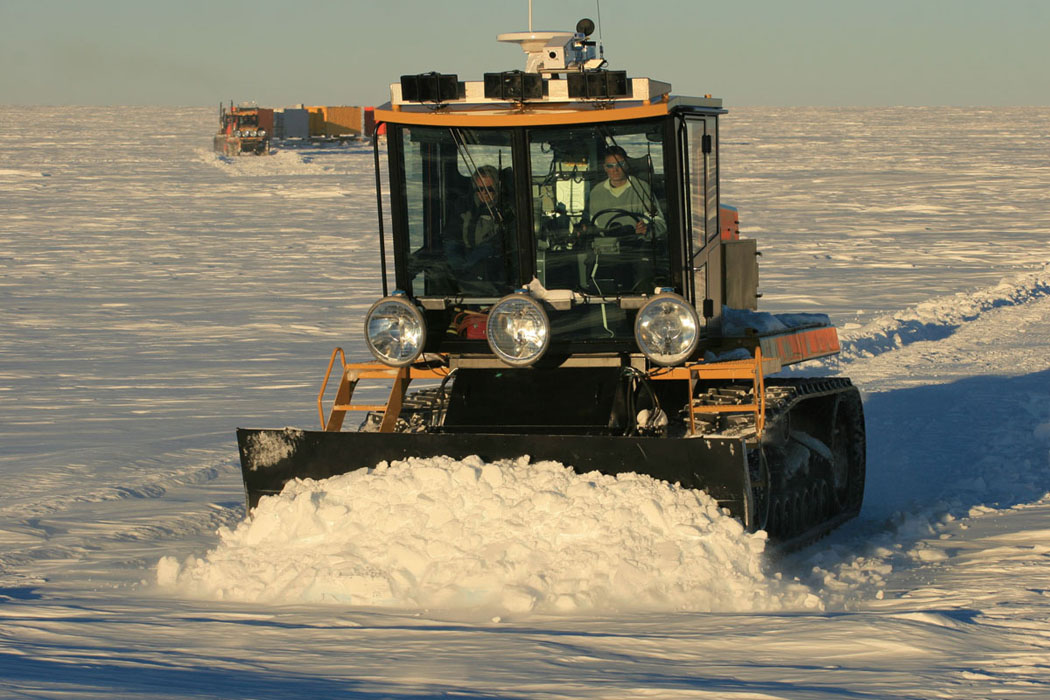
Traverse prototype of a levelling machine based on a Challenger 65C undercarriage in operation
Traverse prototype of a levelling machine
Based on a Challenger 65C undercarriage in operation
Traverse prototype sketch of a levelling machine based on a Challenger 65C undercarriage
Traverse prototype sketch of a levelling machine
Based on a Challenger 65C undercarriage

In keeping with the ongoing effort to improve convoy performance, it was decided to look for the best compromise between speed and robustness for a route-opening vehicle. Given the sound mechanical reliability of the Challenger, built along the lines of a bulldozer, the idea of converting one of these machines for grading work took shape over the early campaigns. What began as a conversion project quickly became a build project, and it is more accurate to say that a genuinely new machine was produced using Challenger components. One requirement was for Camoplast (now Camso Michelin) to manufacture a continuous track of the same type as the standard Challenger track. The extended length reached 405 inches, at 30 inches (762 mm) wide, allowing the undercarriage to be lengthened by an additional pair of bogies.

Track belt and boggies, William Adams Workshop, Hobart
Track belt and boggies
William Adams Workshop – Hobart
Blade from the levelling prototype, William Adams Workshop, Hobart
Blade
William Adams Workshop – Hobart

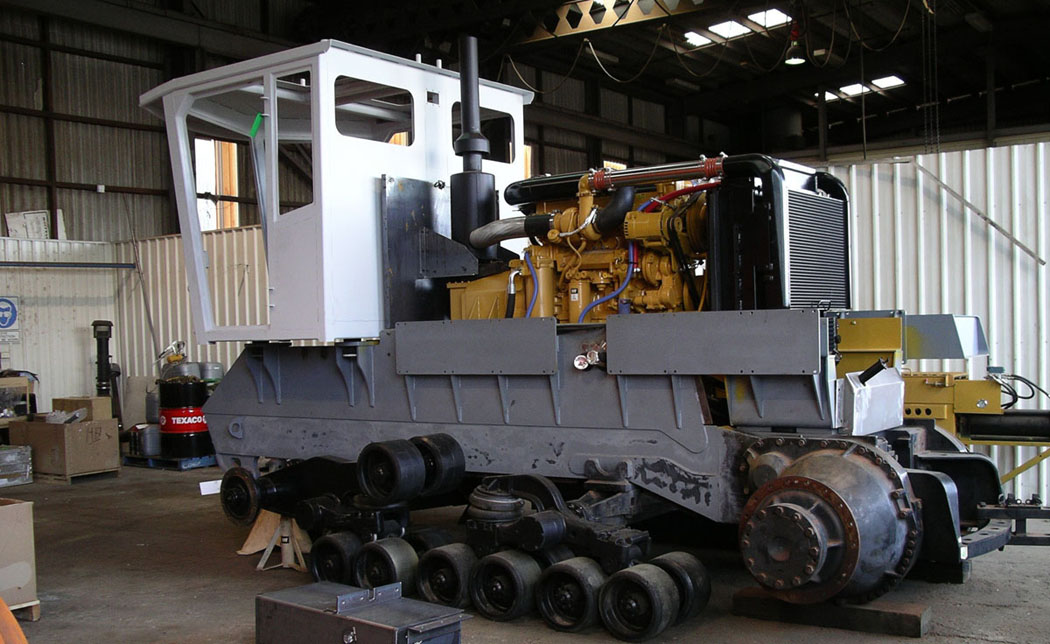
The machine, built by the William Adams Workshop in Tasmania, has the following features. The details below are given in comparison with the Challenger 65C:

• The chassis was raised and lengthened

• A new cab, purpose-built for the machine, was fitted at the front

• The undercarriage was lengthened by an additional pair of bogie wheels

• The tension wheel was moved forward

• The undercarriage comprises 2 x 3 pairs of bogie support wheels

• The original tracks were replaced with a pair of longer tracks

• The engine, radiator and 10-forward/2-reverse gearbox were relocated to the rear, with the engine mounted above the gearbox and linked through a right-angle reduction drive

• Caterpillar C13, 6-cylinder engine, 290 kW

• An articulated blade was fitted at the front

• The vehicle was fitted with all the navigation equipment used on the convoys: three 2,000 W spotlights (powered by a three-phase 400 V / 20 kW alternator built into the engine housing), a multi-constellation satellite navigation receiver providing position and heading (compass function), an infrared camera, and onboard processing electronics.

• Preparation for Antarctic service follows the same standard as the other tractors: sealed engine housing, double-glazed windows, arctic seals, electric heaters and protected air intake.

Traverse prototype levelling machine under construction, William Adams Workshop
Traverse prototype of a levelling machine
Currently in assembly – William Adams Workshop
Traverse prototype of a levelling machine from a Challenger 65C undercarriage
Traverse prototype of a levelling machine
Currently in assembly – William Adams Workshop