
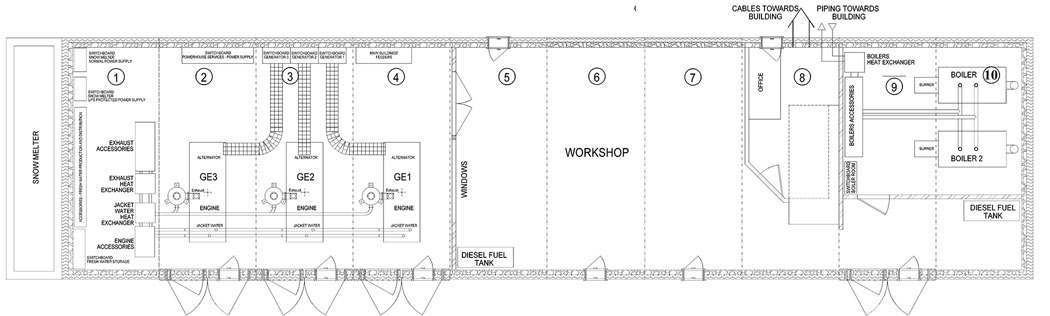
Housing units assy top View / layout
Whilst the two main buildings are polygonal structures on height-adjustable jacks, the powerhouse comprises around twenty modules in 20-foot container format, reassembled on site and arranged on two levels, the whole resting on a steel sled structure allowing the building to be towed as required. The first level contains three main areas: the generator room, a workshop and a boiler room. The second level houses the airlock connecting to the living quarters, a water treatment area and storage for current consumables.
The dominant design parameter for the powerhouse is energy efficiency. Diesel fuel consumption must be strictly limited, both to reduce local environmental impact and to minimise the quantities transported by traverse convoy. Under normal operating conditions, fuel demand is driven solely by electrical load and vehicle use. Overall site consumption is between 280 and 300 m³ per year. Thermal requirements are 95% covered by waste heat recovery from the generator sets. The recovery circuit comprises a ‘primary’ circuit to which independent intermediate circuits — either heat-producing or heat-consuming — are connected via thermal exchangers. This configuration provides considerable flexibility and safety in system management.
Average electrical consumption is approximately 2,400 kWh per day (100 kW continuous). Heat recovered from the cooling circuit is equivalent to this figure, whilst the exhaust provides half that value. Adding the heat dissipated by electrical equipment inside the buildings, the available thermal power comfortably covers all requirements. Simulations confirmed that a maximum heat loss of 75 kW per main building allows normal operation without boiler supplementation.
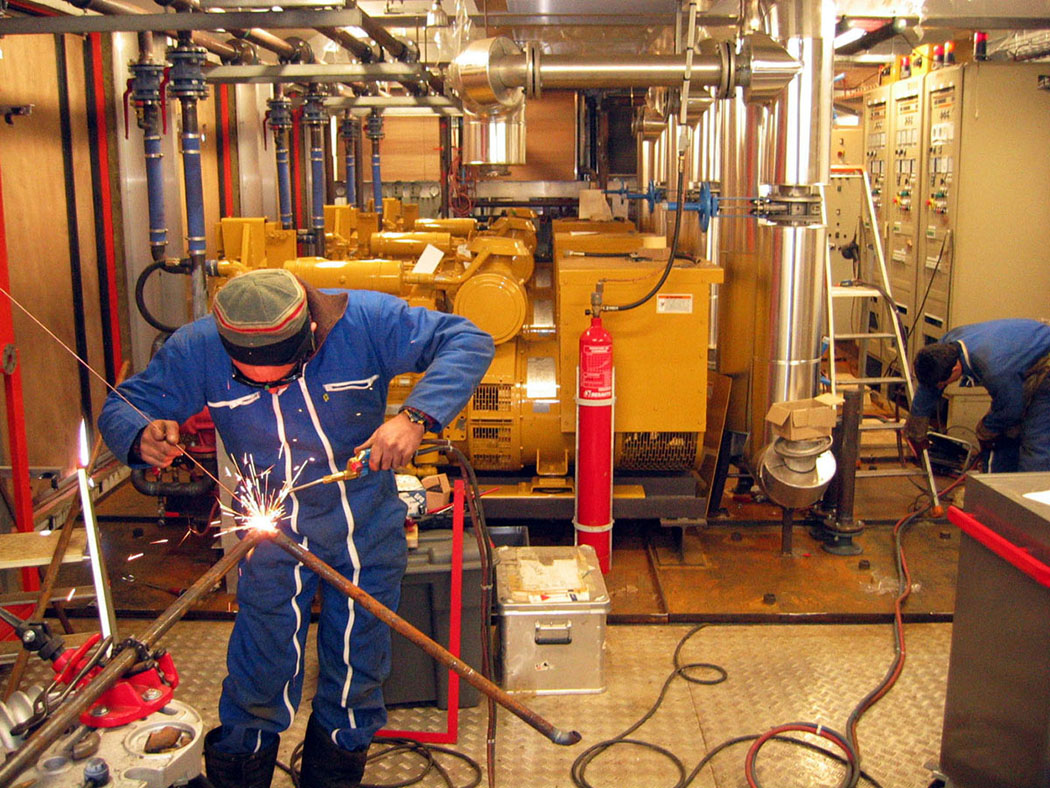
Three generator sets — with only one in service at any given time — are installed in the powerhouse. A fourth backup generator is installed in the ‘noisy’ building. As a further safety measure, two battery-backed inverters provide an uninterruptible supply of 20 kW each for one hour, feeding priority equipment in the event of a power failure.
Sketch of the units of the station building
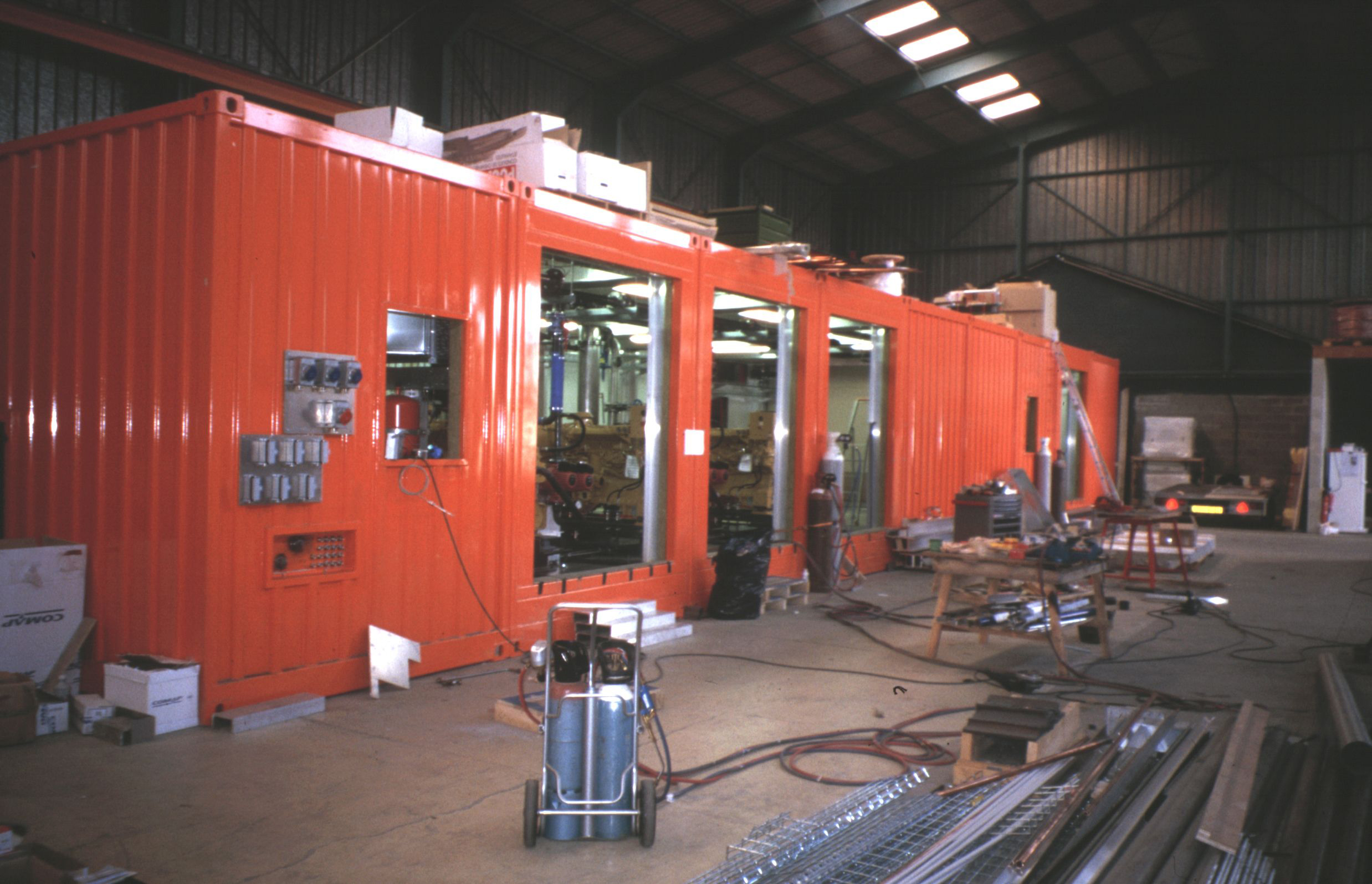
Reassembly on site
The modular construction solution was adopted because it allowed a highly advanced mock mounting of the powerhouse equipment, as well as straightforward transport and on-site reassembly following partial dismantling. The mock mounting was carried out in 1999 in Clermont-Ferrand.
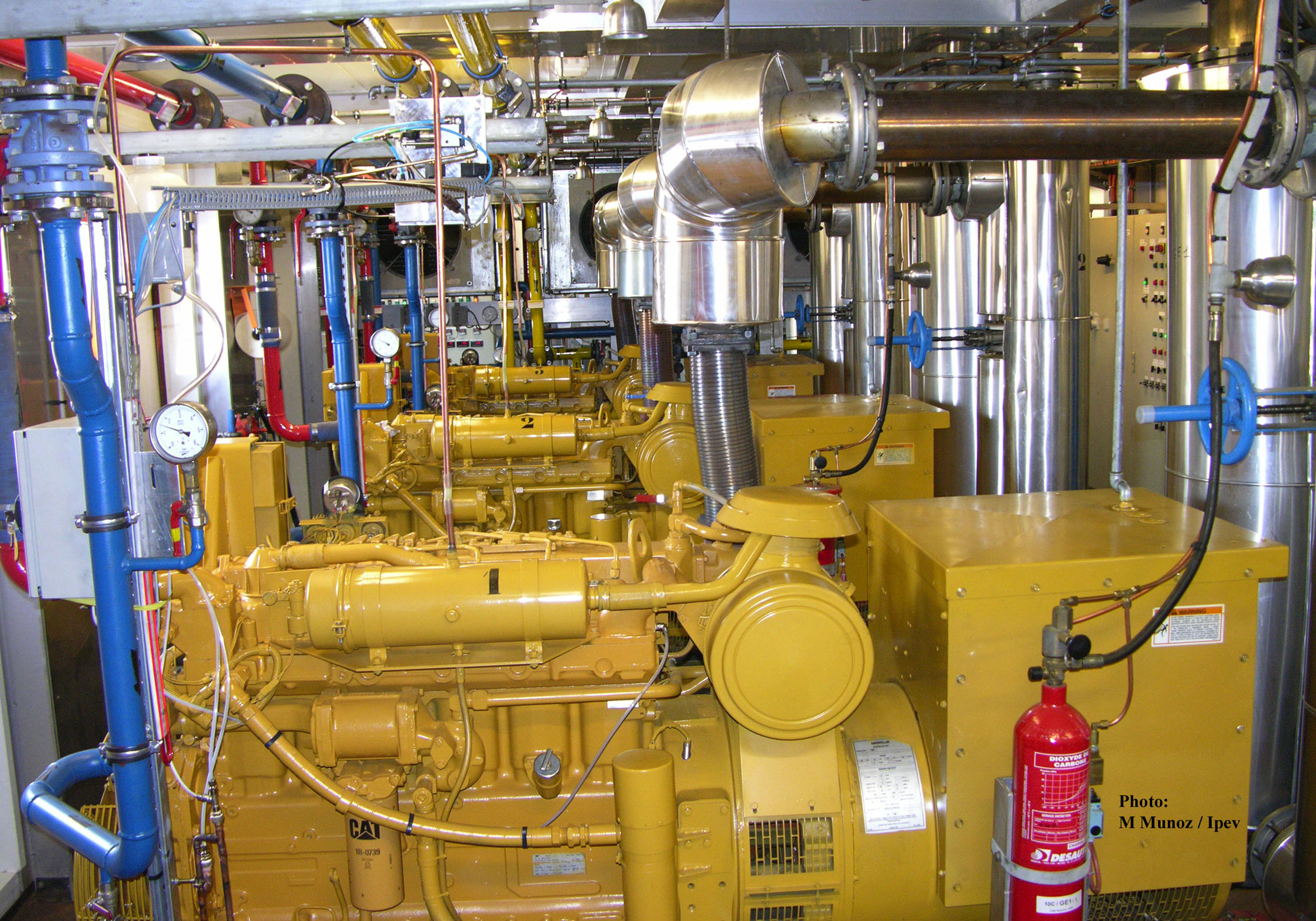
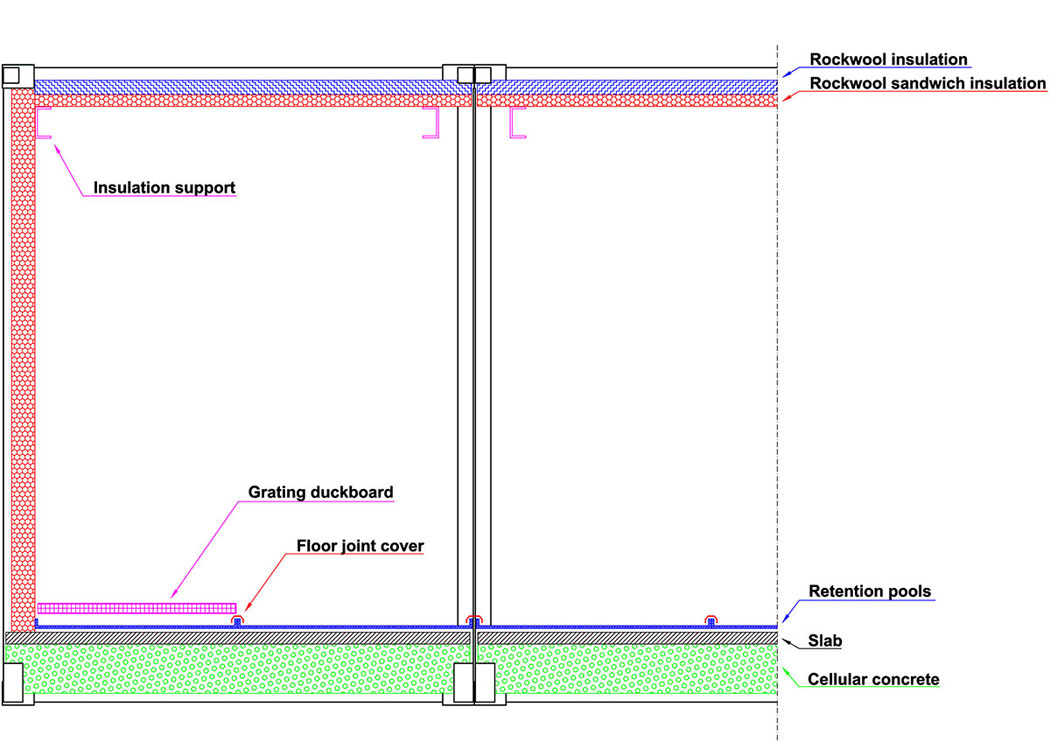
The modular units of the building are constructed and insulated using non-combustible materials, including steel/rock wool sandwich panels. The floor, which must also be insulated, is made up of cellular concrete blocks. The entire surface of the first level (approximately 140 m²) is lined with a steel retention tray designed to collect any liquid spills.
The power station’s energy management is not automatic. The generator sets can run in parallel, but starting and stopping are carried out on human command. This arrangement was preferred over automation for fuel-saving reasons. Rather than adapting production to demand — by starting a second generator following a peak (then stopping it later) — the choice was made to control and regulate demand instead. A computer system assists the operator and smooths consumption by shedding thermal electrical loads. The system calculates the total duration of the power cut, the shedding rate per hour and other variables. If demand cannot be spread out, the operator may decide to create a super peak in consumption by grouping loads to take advantage of the temporary parallel running – for example, tank heaters – so as to anticipate the return to a single generator.